Musk Can Move Millions. Can the Public Move Together?
Small donations can reach billionaire scale. Turning them into accountable political action is the harder job.
Could people supporting non-Republican candidates and causes assemble comparable money, organizing and reach—and keep control of what they build?
The questions behind this essay
Could the public provide similar resources to non-Republicans to counter concentrated political influence?
What tools and technology would make that participation effective and accountable?
What would people need to agree on, and where should they remain free to disagree?
How would participants know who decided, what happened and what remains uncertain?
How this article was created
New prose, source checking, independent reading and page construction have separate roles. The creation record reports supplied model information.
Origin
Andrew supplied the question and editorial direction.
Application
OpenAI Codex
New prose
GPT-6.1-sol · low reasoning effort
Diagram desk
GPT-6-luna · low reasoning effort
Page implementation
GPT-6.1-sol · low reasoning effort
Independent review
Source review: GPT-6.1-sol · low. Fresh independent reader: GPT-6.1-sol · low. Both passed on the selected exact manuscript.
Source limits
Financial Times newsletter excerpt supplied by Andrew; the full article was access-restricted. Associated Press full body and primary ActBlue, FEC, Census and Mobilize sources reviewed. This is not original reporting or a filings audit.
Process
Questions → source ledger → three commissioned versions → separate source and fresh reader review → Captain selection → human publication approval.
Showing the 8-minute version. Reading times are estimates.
A billionaire can make a political decision over breakfast. A million people have to fit theirs around rent, work, children and a hundred competing demands. That is the advantage concentrated money buys before the first advertisement appears: fewer people to ask.
The Financial Times reports more than $275 million in recent political donations from Elon Musk. That is reported spending, not a filing audit performed here, and it proves neither his motives nor an election outcome. But the scale should bother us. I do not think political power ought to depend so heavily on who can write the largest cheque. Financial Times.
Could people supporting non-Republican candidates and causes assemble comparable resources? Yes, in aggregate. ActBlue reports small-donor fundraising on that scale. Its figures cover a different quarter and many recipients; they describe no common reserve. Non-Republicans also disagree with one another. An addition sign cannot supply a shared purpose. ActBlue.
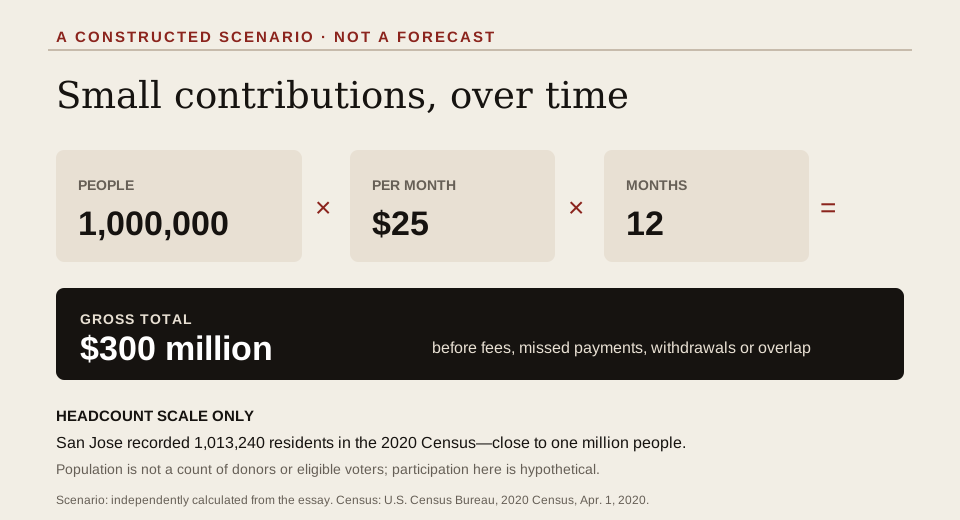
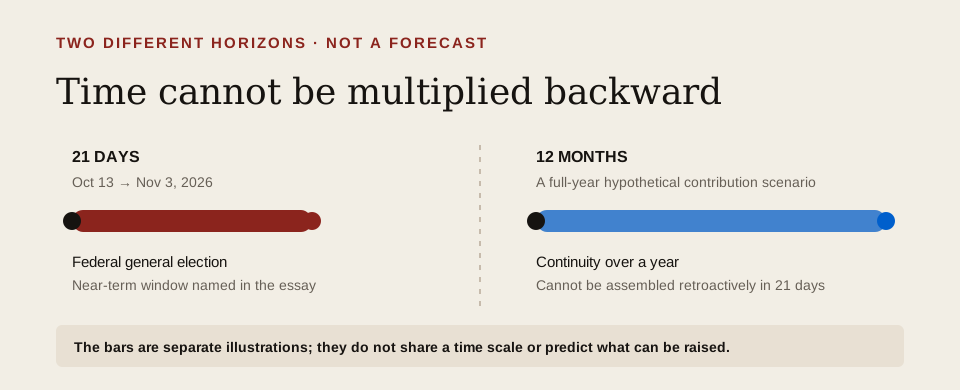
Try a hypothetical: one million people, $25 a month, twelve months. That makes $300 million gross, before fees, missed payments or departures. It recruits nobody. It also cannot fund the remaining twenty-one days between October 13 and the November 3, 2026 federal election. A year cannot be squeezed into three weeks by making the calculator more exciting. FEC election information.
A constructed scenario, not a forecast: one million hypothetical people giving $25 monthly for twelve months produces $300 million gross. San Jose’s 2020 Census population is a headcount scale reference only; it is not a donor or eligible-voter count.Data table: contribution scenario
Constructed gross arithmetic scenario; not a forecast or observed participation
Input
Value
Meaning
People
1,000,000
Hypothetical participants
Contribution
$25 per month
Per person, for twelve months
Duration
12 months
One full year
Gross total
$300 million
Before fees, missed payments, withdrawals or overlapping contributors
Scale reference
1,013,240 residents
San Jose city, 2020 Census (April 1, 2020); headcount comparison only, not donors or eligible voters
Calculation: 1,000,000 × $25 × 12 = $300,000,000 gross. Census source: U.S. Census Bureau QuickFacts, San Jose city, California (https://www.census.gov/quickfacts/fact/table/sanjosecitycalifornia/POP645223).
The 21-day election interval and twelve-month contribution scenario describe different horizons. The bars are separate illustrations, not a forecast or shared time scale.Data table: two time horizons
Two different horizons shown separately; not a forecast or common-scale chart
Horizon
Dates or duration
Interpretation
Election interval
October 13 to November 3, 2026: 21 days
Near-term window named in the essay; federal general election date from FEC
Contribution scenario
12 months
Hypothetical continuity scenario; cannot be collected retroactively inside the 21-day interval
FEC source: Federal Election Commission, election information (https://www.fec.gov/introduction-campaign-finance/election-results-and-voting-information/). Bars in SVG are separate illustrations and do not share a time scale.
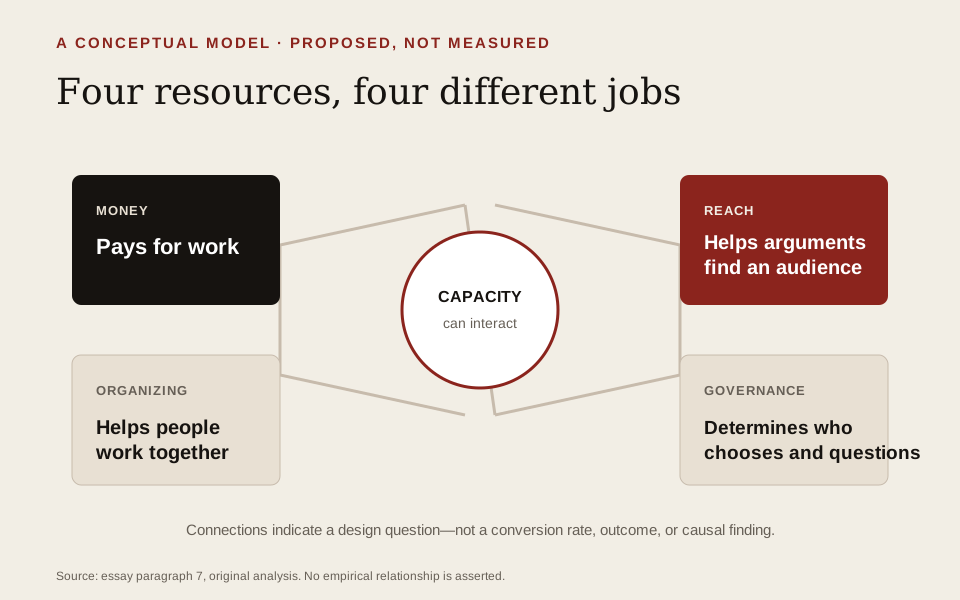
The useful technology would connect money to work and work to responsibility. Let people find a real task, choose what they can contribute, see who decides, and inspect what happened. Time, knowledge and local trust count. A person with no spare money still belongs here.
A conceptual model from the essay: four resources have distinct roles and may interact. Their connections do not represent measured effects or guarantee an outcome.Text equivalent: four resources
Conceptual model proposed by the essay; the connections do not assert measured effects
Resource
Role in the argument
Money
Pays for work.
Organizing
Helps people do work together.
Reach
Helps an argument find an audience.
Governance
Determines who chooses work and who can question the choice.
Original analysis from article paragraph 7. No conversion rates, measured outcomes, or causal effects are asserted.
Money must follow the right legal route. Federal candidate gifts are capped at $3,500 per person per election; permitted super PAC contributions can be unlimited, with independence and reporting obligations. Pooling people does not dissolve those distinctions. FEC limits, committee types.
The strongest objection is obvious: people already give. Another app could drain their time, centralize their decisions and sell them the feeling of participation. Equal money would still not guarantee equal reach, trust or influence.
So start with a specific failure, such as volunteers unable to find usable shifts. Fix it with existing tools where possible. Keep cancellation easy, collect little private data, and distinguish pledges, receipts, completed work and claimed results. Publish the decision process as clearly as the donation total.
My answer is yes to comparable resources, and no to the fantasy that a crowd becomes powerful by appearing on a dashboard. Build the plumbing for accountable action. Do not build another throne and invite the public to pay for it.
Elon Musk does not have to convene a million-person meeting before deciding where his political money goes. That is a hell of an advantage. Ordinary people have jobs, bills, loyalties and reasons to argue. A billionaire can move a huge sum while a distributed public is still trying to agree on the question.
The Financial Times reports more than $275 million in his recent political donations. Treat that as attributed reporting, not an independent audit of filings here. It does not tell us his every motive or what the money will do to election results. It does give us a concrete reason to ask how much political capacity one person should be able to command. Financial Times.
My position is straightforward: concentrated wealth should not enjoy this much advantage in shaping public life. We do not need to invent a crime to object to a distribution of power. Something can operate within the rules and still leave us with a serious democratic problem.
Andrew's question is whether the public could provide comparable resources to non-Republican candidates and causes, and what technology could make that possible. The financial answer is less mysterious than the headline suggests. ActBlue reports aggregate small-donor fundraising at a comparable scale. That is the operator's account, covering another quarter and many recipients, rather than a shared pot waiting to be assigned. It nevertheless challenges the idea that ordinary contributions cannot add up. ActBlue's report.
The practical answer is harder. A hundred separately funded efforts do not become one capable effort because someone adds their totals. Money can be spread across places, objectives and deadlines that have little in common. Some participants will want to support Democrats. Others may support independents or causes that do not fit comfortably inside either major party. Non-Republican is a description of what people are outside of. It is not an instruction about what they should build together.
A public has to make agreement, and it should retain the freedom to refuse agreement. That is cumbersome. It is also the point. If the proposed solution requires everyone to surrender their judgment to a new controller, we have changed the name above the door while keeping the same architecture of power.
The calculator is the easy part
One million people giving $25 a month for twelve months would generate $300 million gross. This is a constructed scenario, not a count of actual participants or a recruitment forecast. Fees, failed payments and departures reduce the usable sum. Some households cannot spare $25. A plan that calls their money painless has already stopped listening to them.
A constructed scenario, not a forecast: one million hypothetical people giving $25 monthly for twelve months produces $300 million gross. San Jose’s 2020 Census population is a headcount scale reference only; it is not a donor or eligible-voter count.Data table: contribution scenario
Constructed gross arithmetic scenario; not a forecast or observed participation
Input
Value
Meaning
People
1,000,000
Hypothetical participants
Contribution
$25 per month
Per person, for twelve months
Duration
12 months
One full year
Gross total
$300 million
Before fees, missed payments, withdrawals or overlapping contributors
Scale reference
1,013,240 residents
San Jose city, 2020 Census (April 1, 2020); headcount comparison only, not donors or eligible voters
Calculation: 1,000,000 × $25 × 12 = $300,000,000 gross. Census source: U.S. Census Bureau QuickFacts, San Jose city, California (https://www.census.gov/quickfacts/fact/table/sanjosecitycalifornia/POP645223).
The date matters too. October 13 is twenty-one days before the November 3, 2026 federal election. An annual scenario describes a longer effort; it cannot supply twelve months of cash for the remaining three weeks. A multiplication sign is not a time machine. FEC election information.
The 21-day election interval and twelve-month contribution scenario describe different horizons. The bars are separate illustrations, not a forecast or shared time scale.Data table: two time horizons
Two different horizons shown separately; not a forecast or common-scale chart
Horizon
Dates or duration
Interpretation
Election interval
October 13 to November 3, 2026: 21 days
Near-term window named in the essay; federal general election date from FEC
Contribution scenario
12 months
Hypothetical continuity scenario; cannot be collected retroactively inside the 21-day interval
FEC source: Federal Election Commission, election information (https://www.fec.gov/introduction-campaign-finance/election-results-and-voting-information/). Bars in SVG are separate illustrations and do not share a time scale.
The calculation is still useful. It turns an intimidating number into assumptions people can examine. Change the number of participants. Change the gift, duration and retention. See what survives. An honest explorer would display those assumptions, collect no donor details, and ask for no payment. It would help people think, rather than use a large total to shove them toward a checkout.
But money is only one resource. Organizing means somebody knows what needs doing, somebody can do it, and the two can find each other. Reach means an argument can get heard. Trust means people have reasons to believe the messenger and can inspect the claim. None has a reliable exchange rate into votes. Matching a donor's total would establish a financial comparison, not proof that an election had been counterbalanced.
A conceptual model from the essay: four resources have distinct roles and may interact. Their connections do not represent measured effects or guarantee an outcome.Text equivalent: four resources
Conceptual model proposed by the essay; the connections do not assert measured effects
Resource
Role in the argument
Money
Pays for work.
Organizing
Helps people do work together.
Reach
Helps an argument find an audience.
Governance
Determines who chooses work and who can question the choice.
Original analysis from article paragraph 7. No conversion rates, measured outcomes, or causal effects are asserted.
Build a way to do something
I would begin with a boring question: what useful work is failing to happen? Perhaps a person willing to help cannot find a shift that fits their schedule. Perhaps a local effort cannot describe its needs clearly. These are proposed examples, not findings from a tested system. They are also better starting points than announcing that democracy needs a new platform.
Existing tools already handle pieces of this work. Mobilize documents event signups and volunteer shifts. That is evidence of a vendor's capabilities, not evidence that its software wins elections. A new layer would need to demonstrate why it helps beyond what organizations already use. Mobilize documentation.
The essential transaction is a promise a person can understand. Here is the task. Here is the time it requires. Here is the person responsible. Here is what happens if it changes. Afterward, here is what was completed and what remains. That applies to giving an hour as much as giving money. A useful interface makes commitments smaller and clearer. It does not turn every expression of concern into a permanent obligation.
Collection should use established services and the correct recipient's systems. For federal candidates, the individual limit is $3,500 per election. Super PACs can receive unlimited contributions from permitted sources for independent activity, subject to the relevant rules. These are different routes. One impressive aggregate must not imply that a public pool can ignore contribution limits, identity checks, independence or reporting. The actual structure needs qualified review before implementation. FEC limits, FEC committee guidance, independent expenditures.
A common view of several efforts need not mean a common bank account. People could inspect separate organizations' purposes and records while choosing their own commitments. Legal boundaries would remain visible. So would disagreement. There is no virtue in making either disappear merely to produce a smoother screen.
Who gets the steering wheel?
Suppose a public effort displays every dollar received and every invoice paid. Good. Now ask who decided to pay those invoices. Financial transparency does not answer a question about authority. A perfectly documented decision can still be imposed on people who had no meaningful say.
Before asking for resources, an effort should state who sets priorities, how those people are chosen, what they can change, and how a participant can challenge a decision. It should explain what happens when goals diverge. Local efforts may need room to act without seeking approval for every detail. Shared commitments may need common checks. The design has to say where each authority begins and ends.
Do not confuse this with a requirement that everyone vote on everything. Endless voting can become another demand on already tired people. Delegation can be sensible. The test is whether the delegated authority is understandable, bounded and answerable. Participants should know what they are handing over before they hand it over.
The same discipline applies to results. A pledge is not received money. Received money is not completed work. Completed work is not proof of electoral effect. Put those distinctions on the record. If a promised activity did not happen, say so. If a result is uncertain, resist the urge to paint a green tick over it. Trust needs a place for unwelcome information.
The strongest argument against another platform
People already contribute substantial sums and effort. Their fragmentation may reflect real differences, rather than a missing application. Another layer could charge them in attention, administrative work and fatigue while improving nothing. It could weaken local judgment by rewarding whatever fits its categories. It could make the loudest organizer more powerful and call the result participation.
This objection should make builders earn their place. Identify a failure. Try a smaller repair. Compare the burden before and after. If an existing arrangement works, use it. If the new system mostly produces dashboards about itself, stop. Civic concern is not an unlimited supply of free labor for somebody else's software ambition.
Access also needs actual choices. A person without constant connectivity should be able to obtain useful instructions. A volunteer who cannot pay should not become a lesser member. Proposed alternatives include printable task sheets, telephone coordination and help through existing local groups. Privacy means asking only for information needed for the commitment, explaining its use, and not turning a volunteer list into a general-purpose database.
Recurring payments require plain consent and easy cancellation. An urgent cause does not make an obscure billing arrangement acceptable. Nor should giving more buy more civic standing. A public effort loses its argument against concentrated power if it reproduces that hierarchy at a smaller scale.
The record should also explain what its measurements mean. Counting a completed shift could tell us that work happened. It would not tell us how many minds changed. A widely shared explanation could show distribution without showing agreement. Useful measurement respects the question it can answer. Inflating a narrow result into a sweeping success story may make a report more exciting, but it gives participants less understanding.
There is a modest place to begin: one defined effort, a small set of needs and a record people can follow. A pilot should expose mistakes while they are still cheap to repair. Participants should be able to say that a feature creates more work than it saves. If the team can learn from that criticism and improve the actual task, the system has earned another step. If it can only ask for more users, it has earned a harder question.
A capacity worth keeping
There is no guarantee this would win. There is no guarantee that equal spending would create equal influence. A credible effort must survive those facts without treating its participants as defective inputs or reaching for another emergency appeal to explain every disappointment.
I would judge the work partly by what remains afterward: clearer relationships, usable records, people who understand their choices, and organizations better able to cooperate without giving up their own purpose. A campaign deadline can focus action. It should not be the only thing holding the whole arrangement together.
The public can assemble comparable financial resources. The more demanding task is to turn resources into action people can inspect and authority they can question. Technology can help with that. It cannot supply the agreement or legitimacy on their behalf.
Build the plumbing: clear commitments, sound legal routes, useful coordination, visible decisions and honest accounts. Let people leave. Let them disagree. Let those without money participate. The point is not to manufacture a public version of a billionaire. It is to give ordinary people more power over what they do together, and fewer reasons to surrender it.
The unnerving thing about a billionaire's political spending is how few people he has to persuade before the money moves. Himself, principally. A distributed public has to persuade one another, fit action around daily life, choose recipients and keep going when the initial outrage wears off. One side begins with a decision. The other begins with a negotiation.
The Financial Times reports more than $275 million in Elon Musk's recent political donations. Associated Press independently reports a similar scale; this essay has not reconciled the underlying filings. These reports establish a large commitment of money, not a finding about his motives, personal policy benefits or the eventual election result. Financial Times, Associated Press.
I think the concentration itself is a problem. Public decisions affect people whose available money differs wildly. A political system in which one person's financial choices can command resources on this scale deserves resistance, even when the spending follows the rules. We do not need a speculative villain story to make that judgment. The distribution of power is enough to argue about.
That leaves a practical question. Could people supporting non-Republican candidates and causes provide comparable resources? And could technology help them act effectively without simply creating a new person at the top who decides for everyone else?
The answer begins with something less flattering to the would-be inventor than a blank slate. Small donors already produce enormous aggregate totals. ActBlue reports $586 million through its platform in the second quarter of 2026: $388 million for federal recipients, $150 million for state and local recipients, and $48 million for charities and civic organizations. Its 15 million contributions are transactions, not 15 million people. These are the operator's figures, from a different period and across many recipients. They are not a coordinated reserve. ActBlue's quarterly release.
That distinction changes where the work belongs. The problem is not that ordinary gifts are mathematically incapable of reaching a large number. The problem is what a distributed total can actually do, who chooses, when the resources arrive, and what participants can understand afterward. A mountain of receipts is not an organization.
A million is a scale, not a constituency
Consider a hypothetical million people giving $25 a month for twelve months. The gross total is $300 million. The equation is simple enough to fit on a napkin. The recruitment, consent, legal structure and sustained participation do not fit beside it.
For a concrete sense of headcount, the Census Bureau recorded 1,013,240 residents in San Jose, California, at the 2020 Census. That is a city population, not a donor pool, voter count or suggestion that those residents support this project. A million hypothetical participants would be a group roughly that size. Imagine the number as people with separate lives rather than a pleasantly round input field. U.S. Census Bureau QuickFacts.
The scenario assumes all of them agree to participate, can afford the gift and continue through the year. Real departures, missed payments and fees would reduce the usable money. Some people would give to more than one effort, so adding several organizations' participant counts could count the same person repeatedly. None of those problems is solved by making the total large enough to feel inevitable.
A constructed scenario, not a forecast: one million hypothetical people giving $25 monthly for twelve months produces $300 million gross. San Jose’s 2020 Census population is a headcount scale reference only; it is not a donor or eligible-voter count.Data table: contribution scenario
Constructed gross arithmetic scenario; not a forecast or observed participation
Input
Value
Meaning
People
1,000,000
Hypothetical participants
Contribution
$25 per month
Per person, for twelve months
Duration
12 months
One full year
Gross total
$300 million
Before fees, missed payments, withdrawals or overlapping contributors
Scale reference
1,013,240 residents
San Jose city, 2020 Census (April 1, 2020); headcount comparison only, not donors or eligible voters
Calculation: 1,000,000 × $25 × 12 = $300,000,000 gross. Census source: U.S. Census Bureau QuickFacts, San Jose city, California (https://www.census.gov/quickfacts/fact/table/sanjosecitycalifornia/POP645223).
Nor is $25 universally spare change. For someone choosing between groceries and a bill, calling it a small gift can be a failure of imagination. An effort that claims to broaden political participation should make room for a person who offers knowledge, a useful hour or a trusted relationship. It should not require a financial audition before treating someone as a citizen.
There is a timing problem as well. On October 13, the November 3, 2026 federal election is twenty-one days away. The annual scenario concerns a longer horizon. It cannot be collected retroactively for the remaining three weeks. Any argument that places the annual total beside an immediate deadline must keep that difference in plain sight. FEC election information.
The 21-day election interval and twelve-month contribution scenario describe different horizons. The bars are separate illustrations, not a forecast or shared time scale.Data table: two time horizons
Two different horizons shown separately; not a forecast or common-scale chart
Horizon
Dates or duration
Interpretation
Election interval
October 13 to November 3, 2026: 21 days
Near-term window named in the essay; federal general election date from FEC
Contribution scenario
12 months
Hypothetical continuity scenario; cannot be collected retroactively inside the 21-day interval
FEC source: Federal Election Commission, election information (https://www.fec.gov/introduction-campaign-finance/election-results-and-voting-information/). Bars in SVG are separate illustrations and do not share a time scale.
A calculator could help readers examine these assumptions. It should show gross and usable amounts separately, with adjustable participation, gift size, duration, fees and retention. It should display the period beside the result. It should describe its figures as scenarios and collect no personal details. The output would be a clearer question: what would have to be true for this capacity to exist? It would not be evidence that those conditions already exist.
The public is allowed to disagree
Non-Republican is not a party, a program or a common bank account. It includes people whose commitments may overlap in one place and collide in another. Some will support Democrats; others independents or particular causes. Some will want to focus locally. Others will believe a national contest deserves priority. Their disagreements may be informed and principled.
Software often prefers a cleaner picture. A shared category is convenient. A single goal makes a progress bar legible. But a legible progress bar is not a mandate. If the public has not agreed on an objective, the interface must not act as though the agreement happened elsewhere.
I would favor bounded cooperation: a clearly stated job, an intelligible decision process and a commitment people actually choose. That could involve several separately governed efforts making their work visible to one another. It need not involve moving every dollar into one pool. Shared information and shared authority are different proposals, and participants deserve to know which one they are being offered.
This is slower than one wealthy person deciding where to send money. We should be honest about the cost. But speed is not the only value in public life. A structure that hears disagreement may avoid a mistake a single controller makes quickly. It may also discover that no shared action is justified. Refusing a project can be a legitimate result, rather than a failure to convert the visitor.
The test is not whether people look unified from a distance. It is whether their cooperation gives them more ability to act on purposes they recognize as their own. A public cannot be built by treating every difference as a glitch in onboarding.
Money needs a destination and rules
The legal route matters before money moves. Federal candidate contributions and independent political spending are not interchangeable. For the 2025–26 cycle, an individual can give $3,500 to a federal candidate per election. Super PACs may receive unlimited contributions from permitted sources for independent activity; relevant independence and reporting rules still apply. A large public aggregate does not bypass the obligations attached to each transaction and activity. FEC contribution limits, committee types, independent expenditures.
That is enough to reject the fantasy of one magic checkout. A person should see the actual recipient, what the commitment is for and what terms apply. Collection should use established services and the appropriate recipient's systems. Any proposed collective structure needs qualified review of its real activities. A diagram of boxes and arrows cannot provide that review.
It is possible to keep a common view while preserving separate legal and practical boundaries. One effort might show its needs, another its scheduled work, another its account of resources received. Participants could choose among them. This is a design proposal, not an assertion that every activity can lawfully be coordinated in every way. The structure has to respect the rules that actually govern it.
I would also separate helping someone understand a commitment from persuading them to make it. Clear information lets a person say yes or no. An urgent interface can instead make refusal feel like betrayal. Even for a cause I support, that would be a rotten foundation for public agency. Consent should mean more than successfully reaching the final button.
Organizing is a chain of kept promises
A volunteer does not need a dashboard about volunteer engagement. A volunteer needs to know where to go, what to do, what to bring, how long it will take, and whom to call if something changes. An organizer needs to know whether the work can actually be covered. That ordinary exchange is where a technology proposal starts earning its keep.
Existing software can already handle parts of it. Mobilize documents event registration and shift management. Those are vendor-described capabilities, not independent evidence of electoral results. They give builders a reason to examine existing tools before commissioning another system. Mobilize documentation.
Suppose, as a proposed example, someone has two hours available and a relevant skill but cannot find a task that uses either. A useful tool could connect the person's offer to a clearly described need. It would establish an owner, a time and a way to confirm completion. If the task is cancelled, it would say so promptly. If the volunteer withdraws, it would make that change manageable.
This sounds unglamorous because it is. Public capacity depends on details that do not look heroic in a launch announcement. A missed instruction can waste the useful hour. An unowned task can leave a willing person waiting. Repeatedly asking people to sign up while giving them nothing intelligible to do is a way to spend their patience.
The work should also accommodate people whose circumstances do not fit the default screen. Printable instructions, telephone coordination and assistance through existing local organizations are possible alternatives. A person should not need uninterrupted connectivity or a new account for every small commitment. Those access routes would themselves need testing; naming them is not proof that they work.
A good system would measure its burden. How much time does a volunteer spend understanding the task? How much administration does the organizer inherit? What happens when the schedule changes? A new layer that saves one person five minutes while creating an hour of clerical work elsewhere has not automatically improved anything.
Reach cannot be bought in the same units as trust
Money can pay for distribution. People can also carry an argument through relationships. Those routes are not equivalent, and a share count cannot tell us what a listener understood or believed. The honest claim is that technology may help material travel and become inspectable. It cannot guarantee that the material deserves trust.
I would want an effort to publish reasons alongside requests: what it is trying to do, what evidence informs that choice and what remains uncertain. Sources should retain dates. Corrections should be visible. Earlier versions should not disappear merely because the newest version is more convenient. An argument that cannot survive inspection should not receive a wider audience as a reward for urgency.
Nor should volunteers become identical megaphones. Someone may support an objective while questioning the proposed message. A participant who spots a weak claim is doing useful work. Treating criticism as disloyalty would make the shared effort less trustworthy precisely when it needs to earn confidence.
This is another limit on the financial comparison. A public could match a donor's spending and still lack comparable distribution. It could have wide reach and still lack trust. It could have trust in one community and little in another. There is no single conversion formula from money to influence, and none from influence to an election result supplied by this research.
A receipt is not a steering wheel
The most dangerous version of this proposal would ask people to counter concentrated power by surrendering their resources to another unanswerable controller. Put an attractive dashboard over that arrangement and it may feel modern. Its political logic is ancient.
Transparency about spending would help, but it would not settle authority. An invoice can show where money went. It cannot tell participants whether the decision to spend it was legitimate. We need to ask who chose the objective, who could change it, and how a disagreement would be handled before admiring the precision of the account.
An effort should state its decision process before asking people to commit. Delegated powers should have boundaries. Participants should know how decision-makers are selected, what information they must disclose and how their choices can be challenged. A local group may need freedom to respond to local conditions. A shared undertaking may need checks against one group's priorities swallowing the rest. The arrangement should explain both.
This does not require a referendum on every purchase. People have limited attention. Delegation can reduce the burden and make action possible. The question is whether people understand what they delegate, whether they can examine its use, and whether the authority can be corrected or replaced under the stated process.
A voting feature would not solve those questions by existing. A meeting no one can attend could reproduce exclusion. An open suggestion box could gather criticism while giving it no effect. A participant needs a usable route from concern to response. Otherwise the system is collecting the appearance of involvement while preserving control elsewhere.
The size of a gift should not determine the weight of a person's civic standing. If an effort opposes concentrated financial influence, building its own hierarchy around contribution size would betray its premise. Resources can differ without turning donors into ranked grades of citizen.
A conceptual model from the essay: four resources have distinct roles and may interact. Their connections do not represent measured effects or guarantee an outcome.Text equivalent: four resources
Conceptual model proposed by the essay; the connections do not assert measured effects
Resource
Role in the argument
Money
Pays for work.
Organizing
Helps people do work together.
Reach
Helps an argument find an audience.
Governance
Determines who chooses work and who can question the choice.
Original analysis from article paragraph 7. No conversion rates, measured outcomes, or causal effects are asserted.
Keep four different things separate
A proposed accountability record should distinguish pledged resources, received money, completed work and claimed outcomes. They belong beside one another so people can follow the chain, but they must not collapse into one success number.
A pledge can be withdrawn or fail to arrive. Received money can sit unused. Work can be completed badly or fail to achieve its purpose. An election result can have many causes. A receipt establishes a narrower fact than a story about why the public won or lost. Preserving that narrowness is a strength: it gives people something solid to inspect.
A financial record should connect spending to supporting documents where appropriate while protecting private details. An activity record should show what was promised and what was delivered. A change of plan should include a reason and identify who made the decision. Someone correcting an error should be able to leave a visible trail instead of quietly replacing the inconvenient entry.
The same record should have room for failure. A task that did not happen should stay distinguishable from a task completed. A claim awaiting confirmation should not become a completed result because an update is due. Public trust cannot depend on everyone agreeing to maintain an optimistic picture.
Privacy belongs in this design from the start. Collect only the information needed for the task. Explain its use. Keep private contact details out of public records. Do not convert a volunteer list into a general asset merely because storing it is easy. Accountability asks decision-makers to explain themselves; it does not require exposing everyone who helped.
Recurring commitments deserve particular care. People should understand the amount and schedule, be able to cancel easily, and know what happens afterward. A worthwhile cause does not excuse ambiguous billing. Leaving should be possible without making the participant argue for permission or endure a moral lecture.
The case against building any of this
Here is the objection I take most seriously: the resources already exist, and the differences are real. A new coordination layer may add expense, bureaucracy and fatigue while solving a problem nobody asked it to solve. It may reward the people most comfortable with its procedures, displace useful local relationships and turn civic action into another account people must maintain.
That objection cannot be answered with ambition. Builders should identify a concrete failure and let the affected people help define a useful improvement. Compare the existing process with a small alternative. Examine burdens as well as benefits. If an established arrangement does the job, use it. If the proposed system mainly produces reports about its own activity, stop calling those reports public power.
The project also has to survive losing. Equal money does not guarantee equal influence; effective organization does not guarantee an election victory. An effort that explains every disappointment by asking people to give more can become an endless demand. Participants deserve an account of what worked, what did not and what the evidence cannot tell us.
My preferred test is what remains available afterward. Can people cooperate more clearly? Can they inspect their commitments and choices? Do local groups retain useful relationships? Can the next effort begin with knowledge rather than another scramble? These are proposed standards for durable capacity, not outcomes already demonstrated here.
A bounded trial would make those standards more demanding. Choose one real coordination problem, with the consent of the people doing the work. Record the existing burden. Introduce the smallest useful change. Ask whether tasks become clearer, changes are communicated reliably and people can find answers without chasing an administrator. Do not declare the whole idea vindicated because one screen behaves as designed.
A trial also needs a stop condition. If it creates more administration than it removes, investigate before expanding. If people cannot understand who has authority, repair that relationship before collecting more commitments. If the underlying organizations disagree on the purpose, stop trying to resolve the disagreement through interface design. The system may need a smaller scope, separate efforts, or no further development.
Those possibilities should remain respectable. Choosing not to build a new platform can be the responsible decision. Choosing to improve an existing tool can be a substantial contribution. Public work does not become less valuable because the person solving the problem cannot put their own logo on the solution.
Finally, the people participating should be able to inspect the trial's conclusion. What changed? What evidence supports the judgment? What did the organizers decide not to measure, and why? A successful small test would support only the next bounded step. It would not license a promise that scale will preserve every benefit. More participants can introduce new demands on authority, access and privacy; the next step needs its own examination.
Build the plumbing, keep the power
The financial comparison is possible in aggregate. The evidence does not establish comparable control, reach or electoral effect. That gap should sharpen the ambition. Money helps work happen. People need ways to choose that work, carry it out and question the people directing it.
I would invest in those connections: sound legal routes, clear tasks, accessible participation, bounded authority, source records, honest accounts and easy exits. Build small enough that a failure can be seen and repaired. Let cooperation expand because it is useful, rather than because a grand total makes expansion feel compulsory.
A public's worth is not determined by whether it can outspend Elon Musk. People do not become more entitled to a say when the crowd reaches a million. The point of comparable capacity is to make their existing right to participate harder to overwhelm.
Technology has a legitimate job here. It can make promises clearer, decisions more inspectable and useful action easier to join. It should leave people more capable of choosing together, including choosing differently. Build that plumbing. Keep the steering wheel visible. And do not ask the public to finance another throne.
October 12, 2026 (reported article date) · Financial Times reporting supplied as a newsletter excerpt. The original headline was visible; the full article remained behind its access screen. No article-body screenshot is reproduced.
October 12, 2026 · Associated Press article read in the browser; reporting corroborates the donation scale. A connection interruption prevented the limited headline capture. No licensed photograph or full article is reproduced.
Publication date not recorded · Captured browser viewport, October 13, 2026; government source. This view identifies the page and visible facts, not the entire document.
Publication date not recorded · Captured browser viewport, October 13, 2026; government source. This view identifies the page and visible facts, not the entire document.
Publication date not recorded · Captured browser viewport, October 13, 2026; government source. This view identifies the page and visible facts, not the entire document.
Publication date not recorded · Mobilize vendor capability documentation, full page read; not evidence of electoral effectiveness. No screenshot is reproduced.
Publication date not recorded · Captured browser viewport, October 13, 2026; government source. This view identifies the page and visible facts, not the entire document.
2020 Census population reference · Captured browser viewport, October 13, 2026; government source. This view identifies the page and visible facts, not the entire document. Selected 2020 Census population: 1,013,240; a headcount example, not a donor or eligible-voter count.